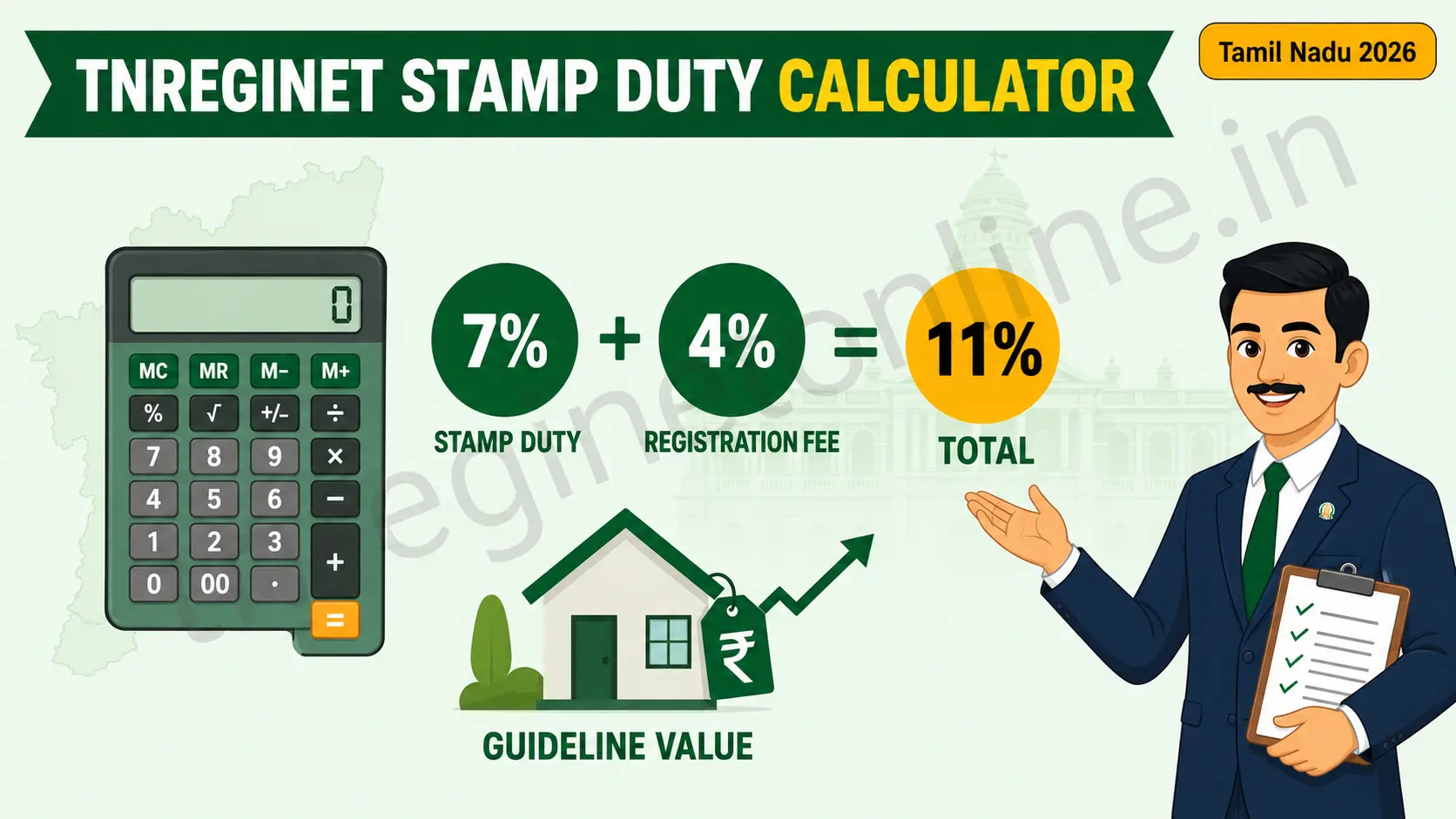
The TNREGINET stamp duty calculator gives you one number, and getting it right matters more than most buyers realise. For a sale deed in Tamil Nadu, stamp duty is 7% of the market value and the registration fee is 4% of the market value, a combined statutory cost of 11%. Critically, that percentage is applied to the sale price or the government guideline value, whichever is higher.
If you have been searching this topic, you have probably noticed something unsettling: the websites do not agree with each other. Some say the registration fee is 4%. Others say 2%. Others say 1%. Some promise women buyers a concession; others insist Tamil Nadu offers none at all.
That contradiction is not harmless. On a fifty-lakh property, the difference between a 4% and a 2% registration fee is a full lakh of rupees that either is or is not sitting in your account on registration day. So this guide does something the others do not: it works from the Tamil Nadu Registration Department’s own published fee schedule, and it gives you the complete deed-wise table, including the rupee ceilings that almost every other page silently omits.
The official rates behind the TNREGINET stamp duty calculator
Stamp duty in Tamil Nadu is not a single number. It changes entirely depending on what document you are registering, and several categories are capped in rupees rather than running as an open percentage. That capping is where most online calculators quietly get it wrong.
Here is the schedule as published by the Inspector General of Registration.
| Document type | Stamp duty | Registration fee |
|---|---|---|
| Conveyance (Sale) | 7% of market value | 4% of market value |
| Gift | 7% of market value | 4% of market value |
| Exchange | 7% of the greater value | 4% of the greater value |
| Simple mortgage | 1% of loan amount, max ₹40,000 | 1% of loan amount, max ₹10,000 |
| Mortgage with possession | 4% of loan amount | 1%, max ₹2,00,000 |
| Agreement to sale | ₹20 | 1% on money advanced |
| Partition (family) | 1%, max ₹25,000 per share | 1%, max ₹4,000 per share |
| Partition (non-family) | 4% on separated shares | 1% on separated shares |
| Settlement (family) | 1%, max ₹25,000 | 1%, max ₹4,000 |
| Settlement (other cases) | 7% of market value | 4% of market value |
| Release (family co-parceners) | 1%, max ₹25,000 | 1%, max ₹4,000 |
| Release (non-family) | 7% of market value | 1% of market value |
| Deposit of title deed | 0.5% of loan, max ₹30,000 | 1% of loan, max ₹6,000 |
| Lease below 30 years | 1% of total rent/premium | 1%, max ₹20,000 |
| Lease up to 99 years | 4% of total rent/premium | 1%, max ₹20,000 |
| GPA to sell (family member) | ₹100 | ₹1,000 |
| GPA to sell (non-family) | ₹100 | ₹10,000 |
Note on these figures: the rates and rupee ceilings above reflect the Registration Department’s published schedule at the time of writing. State governments revise stamp and registration provisions through budget notifications, and a change can take effect without much public warning. Confirm the current figure for your specific deed type on the official portal or at your Sub-Registrar Office before you transfer any money.
The three things the table quietly tells you
Read that schedule again and three practical facts emerge that no percentage-only summary can give you.
Keeping it in the family changes everything. A settlement, release, or partition among family members attracts 1% duty capped at ₹25,000, with the registration fee capped at ₹4,000. The same transaction among non-family parties jumps to 7% uncapped. On a property worth a crore, that is roughly the difference between paying about ₹29,000 and paying ₹8,00,000. If your transfer is genuinely intra-family, the deed type you choose matters more than any other decision in this process.
Caps are the detail everyone omits. Notice how many entries are not open percentages at all. A simple mortgage is 1% of the loan but never more than ₹40,000 in duty. A deposit of title deed, the deed your bank registers when it takes your property as security for a home loan, is 0.5% of the loan capped at ₹30,000 in duty and ₹6,000 in fee. Online calculators that just multiply by a percentage will happily overstate these by lakhs.
A gift is not a shortcut. This one catches people out. In the published schedule, a gift deed carries the same 7% duty and 4% fee as an outright sale. The concessional 1% rate people have heard about applies to settlement and release deeds within a family, which are different instruments. If someone advises you to just gift it to save duty, ask them to show you where.
The guideline value trap that inflates your bill
Here is the mistake that costs buyers the most money, and it has nothing to do with the percentage.
Stamp duty is not calculated on what you paid. It is calculated on the higher of two figures: your actual sale consideration, or the government’s guideline value for that locality. You cannot register a property below its guideline value, so if the government says a plot is worth more than you paid for it, you pay duty on the government’s number.
Work it through with a real example.
Scenario: You are buying a flat in Coimbatore. The agreed sale price is ₹50,00,000. The guideline value for that street works out to ₹55,00,000.
The portal will not use your ₹50 lakh. It will use the higher figure, ₹55,00,000.
- Stamp duty at 7% of ₹55,00,000 = ₹3,85,000
- Registration fee at 4% of ₹55,00,000 = ₹2,20,000
- Total statutory cost = ₹6,05,000
Had you budgeted on your ₹50 lakh sale price, you would have expected ₹5,50,000 and arrived at the Sub-Registrar Office ₹55,000 short. That shortfall is not negotiable at the counter.
The lesson is simple and it is the single most useful thing on this page: check the guideline value before you check the calculator. Our guide on guideline value in Tamil Nadu and how it differs from market value walks through the lookup. Do that first, then compute.
Budget the other way too. If your sale price is higher than the guideline value, duty is charged on your sale price, not the lower government figure. The rule cuts both ways: it is always the higher of the two, never the more convenient of the two.
How to use the TNREGINET stamp duty calculator
The portal’s own calculator sits under Duty and Fees, and it is the figure the Sub-Registrar Office will work from. Here is the sequence.
- Check the guideline value first. Look up the guideline value for your street or survey number on the portal, so you know which figure the duty will actually be applied to. Doing this after you calculate defeats the purpose.
- Log in to the official portal. Go to tnreginet.gov.in and sign in with your registered credentials, or create a free account if you do not have one.
- Open Duty and Fees. From the homepage, scroll to the Duty and Fees section. This is where the department publishes the fee structure and the calculation tools.
- Select your document type. This is the step that decides everything. Sale, gift, settlement, release, partition and mortgage all carry different rates and different caps, as the table above shows. Selecting the wrong instrument produces a confidently wrong number.
- Enter the correct value. Enter the higher of your sale consideration or the guideline value you looked up in step one. For a mortgage or title-deed deposit, enter the loan amount rather than the property value.
- Read the breakdown, not just the total. The output should separate stamp duty from the registration fee. Check that any applicable cap has been applied, since the capped categories are where errors hide.
- Generate the e-payment and pay. Create the payment application, pay through net banking or the available online modes, and download the e-receipt. Carry that receipt to the Sub-Registrar Office on your appointment date.
If your payment goes through the gateway but the portal does not acknowledge it, that is a known and recoverable situation. Our guide on payment failed but amount debited on TNREGINET covers what to do before you try paying twice.
Mistakes that cost people real money
Assuming the home loan covers it. Lenders generally disburse against the property’s purchase price. Stamp duty and registration charges are usually paid from your own funds, on the day, in addition to your down payment. On an 11% statutory cost, that is a substantial sum people routinely forget to set aside.
Budgeting on the sale price instead of the guideline value. Covered above, and worth repeating because it is the most common shortfall at the counter.
Trusting a third-party calculator that hardcodes 7% plus 4%. That pair is correct for a sale deed and wrong for most other instruments. A partition among family members computed at 11% will overstate the cost by an order of magnitude.
Missing the registration window. A document must be registered within four months of execution. Delay past that and you are into penalty territory, which is entirely avoidable cost.
Forgetting the other charges. Beyond duty and fee, budget for the document writer or advocate, the Patta transfer after registration, and the encumbrance check you will want before you commit. Run a TNREGINET EC search on the property first, since discovering a mortgage after you have paid duty is an expensive way to learn.
Frequently asked questions
What is the stamp duty and registration fee for a sale deed in Tamil Nadu?
Stamp duty is 7% of the market value and the registration fee is 4% of the market value, giving a combined statutory cost of 11%. The percentage is applied to the sale price or the government guideline value, whichever is higher.
Is stamp duty calculated on the sale price or the guideline value?
On whichever is higher. If the guideline value exceeds your agreed sale price, duty and fee are computed on the guideline value. A property cannot be registered below its guideline value in Tamil Nadu.
Do women pay less stamp duty in Tamil Nadu?
Stamp duty itself is not reduced on the basis of gender in the department’s published schedule. Some sources describe registration-fee concessions in narrow circumstances, and these vary and change. Since this directly affects what you pay, confirm your specific position on the official portal or with your Sub-Registrar Office rather than relying on any website.
Is a gift deed cheaper than a sale deed in Tamil Nadu?
Not in the published schedule. A gift attracts the same 7% stamp duty and 4% registration fee as a conveyance. The concessional 1% treatment applies to settlement and release deeds among family members, which are different instruments.
Where is the stamp duty calculator on TNREGINET?
Log in to tnreginet.gov.in and open the Duty and Fees section from the homepage. Select your document type, enter the applicable value, and the portal returns the stamp duty and registration fee. Check the guideline value before you calculate.
Can I pay stamp duty online in Tamil Nadu?
Yes. Generate the e-payment application on the portal, pay through net banking or the available online modes, and download the e-receipt to carry to the Sub-Registrar Office on your appointment date.
In short: the TNREGINET stamp duty calculator is only as good as your inputs
The TNREGINET stamp duty calculator returns an accurate figure only if you give it two accurate inputs. Choose the correct instrument, because a family settlement and an outright sale are separated by lakhs. Then feed it the higher of your sale price and the guideline value, because that is the figure the government will use whether you budgeted for it or not.
Next step: look up your guideline value, then run the calculation under Duty and Fees at tnreginet.gov.in. For help with the portal, the Registration Department helpline is 1800 102 5174. Rates, caps and contact details are accurate at the time of writing and may be revised, so verify the current figures on the official portal before you pay.
Related services on this site
- Guideline Value Tamil Nadu: look this up before you calculate, since it decides the figure your duty is charged on.
- TNREGINET EC Search: check the property’s encumbrance history before you commit money to the purchase.
- Payment Failed But Amount Debited: what to do when the gateway takes your money but the portal does not confirm it.
Last updated: July 2026. TNREGINETonline.in is an independent guidance site and is not affiliated with the Government of Tamil Nadu or the Registration Department. Stamp duty and registration provisions are set by the state and can be revised through notification. Always verify current rates on the official portal, tnreginet.gov.in, or with your Sub-Registrar Office before completing any transaction.
